


 Quick Help - Reviews
Ordinary Days at the Rosemary Branch Theatre
By Carolin Kopplin

What am I doing here?
Atomicus Entertainment presented a new American chamber musical by the talented Adam Gwon at the Rosemary Branch Theatre for a limited run. Ordinary Days tells the story of four young New Yorkers whose lives intersect as they search for their way to happiness in the city that never sleeps.
The show opens with Warren, a budding artist who assists an already established artist "like Banksy" by catsitting and distributing flyers: "I shout it from the rooftop loud and clear but who will hear." Tired of her dull office job, Deb came to New York from a little town in the middle of nowhere to finish her master's degree: "Since I'm a dork I moved to New York." She is in the final stages of her thesis. When she loses her notes in the subway, Deb is desperate. Claire is moving in with her boyfriend Jason but won't throw anything away because she can't let go of her memories.
The four protagonists all come together when Warren finds Deb's notes and is going to meet her in the Metropolitan Museum of Art -Deb gets terribly lost and becomes more irritated by the minute. In one of the funniest scenes Warren finds Deb who is not in a good mood by now and even forgets to thank him for bringing her notes: “I sensed from your notebook your fiery nature,” Warren remarks. “Your penmanship crackles with rage.” Deb agrees to go for a coffee after confirming her suspicion that he is gay. The ever driven Deb has no time for people without ambition or determination, people like Warren, that is. Jason and Claire also visit the MET and find themselves in different wings of the museum - Jason preferring the classics whilst Claire is attracted to modern art. This is only the beginning of a journey to discovering everything that separates them.
Adam Gwon's lyrics in this nearly sung through production are funny, touching and to the point, describing the thoughts and feelings of the four young people who are contemplating their immediate futures. Katie Brennan is excellent as the quick witted Deb who discovers that there is more to life than blind ambition. Christopher Keating is lovely as Warren, the good natured assistant-artist whose hobby is scavenging discarded items such an unopened Valentine's card - or Deb's notes. Alexander Parker and Katriona Perrett are very good as Jason and Claire, the couple that is drawn apart by moving in together.
Ordinary Days is a delightful musical with lovely melodies, witty lyrics and intriguing characters.
By Carolin Kopplin
The run has now ended.
More info on Atomicus Entertainment:
Without Reluctance and Without Remorse at the Brockley Jack Studio Theatre
By Carolin Kopplin

But why go to Bombay when you can go to Bedford?
Although the Brockley Jack Studio Theatre seems a bit far away from central London, it is really not. There are trains from Euston and Elephant and Castle, the P4 from Brixton, the Overground... and a trip to the Jack is always worth it because you get to see productions of a consistently high quality and usually creative and innovative theatre. Writer in residence Howard Colyer has contributed to this quality with his skilful adaptations of Russian masters, such as Flight and Boris Godunov. His latest work for the Jack consists of three monologues for three actors. The production is presented by Ballast Theatre and directed by John Fricker and Sean Turner.
The first monologue called Again is quite short. A man (Warren Taylor) has been abandoned by his volatile girlfriend during their holiday at the seaside and he comments on the nature of their relationship. It ends quite abruptly and leaves you wondering what it is all about.
The second monologue takes us to Deptford. You Take the 321 is the story of a young woman with an Indian background who is striving for independence from her overbearing parents. She moves to Deptford, against their explicit wishes, and immediately finds her way to a pub called "The Dirty South". To prove her self-reliance she buys a property and becomes landlady to an already existing tenant - an old man from Poland named Thomas Kowal. When her tenant dies suddenly, having named her as his sole heir, she begins investigating his life. This is a fast-paced, exciting piece although Avita Jay's performance mostly remains on the same note, which might have been due to insufficient rehearsal time.
Without Reluctance and Without Relief features the outstanding David Bromley as the manager of a software company, owned by his family. He is interviewing a candidate (Warren Taylor) wearing a military uniform - but is the Visitor really a candidate? He never speaks a word, just watching and listening to the manager who becomes more and more agitated as he recounts the history of his company and in in the end spirals completely out of control, describing visions of a future armageddon. The Visitor remains a mystery throughout the monologue. This is the most fascinating and challenging piece of the evening.
Although the first monologue is too short to take us anywhere, You Take the 321 and Without Reluctance and Without Relief are exciting and at times unnerving journeys. Howard Colyer paints lyrical landscapes of failed relationships, loneliness and desperation without ever giving in to sentimentality.
Despite minor flaws, this is thought-provoking theatre.
By Carolin Kopplin
The run has now ended.
Harajuku Girls at the Finborough Theatre
By Carolin Kopplin

Yumi (Kunjue Lee) and Keiko (Elizabeth Tan) -- Photo by Alexander Newton
In this country everyone is pretending.
As part of the Vibrant New Writing season, the Finboroough presents the world premiere of Harajuku Girls by Irish-Japanese playwright Francis Turnly, directed by Jude Christian. Set in contemporary Japan, the play focuses on the themes of individuality versus tradition, fantasy as a means to cope with reality, and the importance of friendship.
Cosplay is not limited to a few people dressed up as characters from comic books or video games at film and comic conventions. On Jingu Bridge in Tokyo, for example, teenage girls dress in cosplay outfits for fun, fashion, and the fantasy of being someone else. Mari, Keiko and Yumi are three of these girls but after finishing school they have to face the harsh realities for women in their society. Yumi is stuck in a deadend job up to the day when she finds a husband to become a housewife for the rest of her life. Mari dreams of being an actor but acting schools are expensive and her father expects her to be realistic and work in an office job. Keiko wants to be independent and live the good life now so she finds her way to Kabukicho, an amusement district with panty shops, love hotels, and image clubs to make her living by selling fantasies to men.
The performance opens with Keiko and Mari on their last day of school. They have been friends throughout their time at school yet have grown apart from Yumi who is more traditional and accepting than her former friends. Keiko takes Mari to a panty shop to sell their school uniforms, obviously for schoolgirl fantasy games. They are going to meet up for cosplay later. Mari's father is very critical of cosplay. A traditionalist, he believes in hard work and spends his evenings working or drinking with his boss because he thinks this is expected of him. He is deadset against Mari becoming an actress, a profession he considers little better than prostitution. His wife spends many lonely evenings, trapped in the role of a lonely housewife. Keiko fulfills her material dreams with a rich older boyfriend - for the time being.
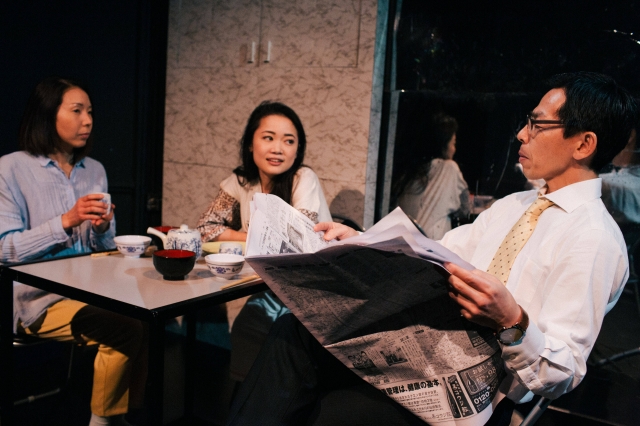
Mrs Okada (Meg Kubota), Mari (Haruka Abe) and Mr Okada (Nomo Gakuji) -- Photo by Alexander Newton
This is an exciting and intriguing new play about three girls who try to live their lives their way against all odds. Restrained by a traditionally patriarchal society, Mari and Keiko end up choosing rather unorthodox means to reach their goals.
The production is well cast although some of the actors fumbled their lines on a few occasions, which might, however, have been due to press night stress. Haruka Abe conveys the dilemma of Mari, who has to antagonise her father to fulfil her dream of becoming an actor. Kunjue Lee convinces as the somewhat subdued Yumi who is willing to obey her father's wishes. Nomo Gakuji and Meg Kubota are very good as Mari's parents - Mrs Okada understands her daughter's dreams but bows to her husbands wishes. Mr Okada, a disillusioned man, sees his duty to his employer to support his family as the only thing that counts in his life and expects his daughter to obey. Keiko (Elizabeth Tan) is an adventurous, almost reckless woman who seems to be entirely ruled by materialism. Sadao Ueda convinces as the rather predatory male characters in this play such as the owner of the panty shop and Keiko's married boyfriend.
The set by Cécile Trémolières resembles Japanese architecture in its simplicity and comes with sliding doors. It proves quite versatile for the various changes of location. Yet, there were a number of props that had to be moved around for scene changes and as there were many of them, it did disturb the flow of the performance somewhat.
A fascinating and bold play.
By Carolin Kopplin
Until 21st March 2015
Finborough Theatre
118 Finborough Road, London SW10 9ED
Telephone 020 7244 7439
Hindle Wakes
By Kirstie NilandThe Octogan Theatre, Bolton
Hindle Wakes is a good old Lancashire yarn, set in a fictitious town just before the First World War. It focuses on two sets of parents and their offspring, Fanny Hawthorn and Alan Jeffcote, who are discovered to have spent a secret weekend alone together.
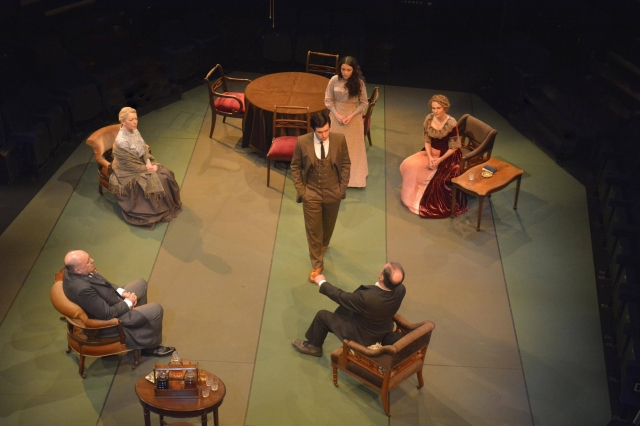
To make matters worse, Fanny is a weaver at the local mill and Alan is the mill owner’s son. Their fathers have been friends since they were boys but that doesn’t make it socially acceptable. Even worse, Alan is engaged to Beatrice, the daughter of local bigwig, Sir Timothy Farrar.
Oh dear...there’s going to be trouble at mill.
Fanny and Alan have gone separately to Blackpool during Wakes Week, the annual holidays when all of Hindle’s workers down tools. After meeting up they decide to disappear for what would now be known as “a dirty weekend” in Llandudno. Their friends cover for them but a tragedy alerts Fanny’s parents to the truth.
Once their secret is revealed Alan is pressured to marry Fanny and there ensues a series of funny, touching and frustrating conversations involving both families, which result in Fanny turning him down. It’s great to see Colin Connor in a more light-hearted role as Beatrice’s father after some of the intense characters he’s played recently. His portrayal of a well-to-do man about town who sees nothing wrong with such an indiscretion - until he fears it will impact on him financially - has perfect comic timing.
Tristan Brooke puts in a fine performance as the feckless Alan, and Natasha Davidson is utterly believable as the feisty weaver who puts him in his place. Between them, the cast play out the social conventions stereotypical of the day with aplomb.
The simple set echoes their differences, beginning with a sparse gathering of furniture for the Hawthorn's home, which expands to become a more luxurious layout for the Jeffcote's.
When Stanley Houghton wrote Hindle Wakes in 1910, not only was it unusual to have a working class woman as the main character, but one with a Northern accent who sees no problem with a pre-marital fling would have been unheard of. Therefore the play caused plenty of controversy when it was first performed in 1912.
While today's audience may have chuckled when Fanny was branded a “hot blooded little wench,” who was “jolly immoral,” in those days this carry on would not have been a laughing matter. Yet we see Fanny earn a grudging respect from Alan’s Mother, and even praise from the spurned lover himself: “You’re a damn good sport.”
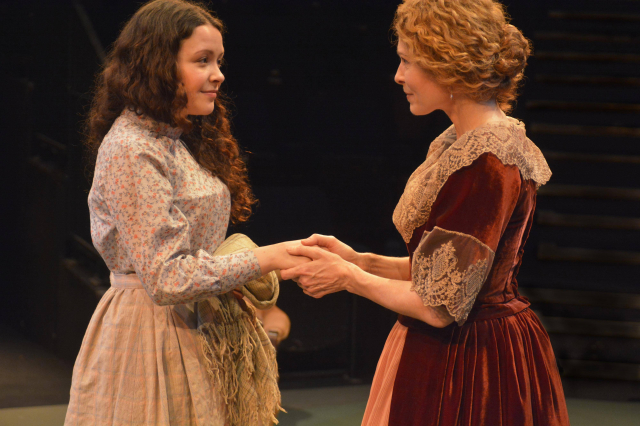
As Alan sets off jauntily to see if his ex-fiancée will take him back, and Fanny remains content with her freedom, we applaud the spirit of independence which was well before her time – you go girl!
Meanwhile the men, as ever, remain perplexed about women, as Jeffcote muses: “And these are the creatures that want us to give them votes!”
Outrageous!
Photographs by Ian Tilton
Hindle Wakes is on until 21st March.
Tickets: £26.50 - £10, discounts available including SEASON TICKETS, groups, schools and young person's £5 tickets. Available on 01204 520661 or at www.octagonbolton.co.uk.
Yarico at the London Theatre Workshop
By Clare Brotherwood
The story of Yarico, an Amerindian woman who saved the life of and subsequently fell in love with a British merchant who then sold her into slavery on the island of Barbados, has been around since the 1600s. Since then there have been more than 60 retellings including an opera in 1787, which added fuel to the growing debate on the ethics of slavery.
Now it is being revived – by Jodie Kidd, who is co-producing it with her father John at the London Theatre Workshop above a pub near Fulham Broadway.
But if you think this is just a whim of the former supermodel and TV presenter, you are mistaken. Jodie was brought up in Barbados where the story was re-enacted at her mother Wendy’s arts festival, and she thinks it is of great historical significance, reminding us of the value of freedom, and needs to be heard again, not only on stage but in schools and cultural institutions both here and in the Caribbean.
The 10-year labour of love couldn’t have got off to a better start. A standing ovation ended the press night of the world premiere in which the appropriately named Liberty Buckland, a graduate of the Royal Academy of Music, is making her professional debut in the title role.
It was hard to imagine how as many as 10 actors at one time could even move on so small a stage but from the first sound of crickets and the crashing of waves, we were transported to a faraway place. And within just a couple of minutes the actors had already established their characters, making the stage not a crowded but a busy, bustling place.
The bamboo hanging from the ceiling and the shiny black walls and floor, which conjured up a dense, sweaty place, added to the atmosphere, as did the basic sackcloth costumes of the characters.
But this is a musical, and almost tribal, hypnotic drums and percussion sit easily beside catchy tunes and haunting ballads under the able direction and orchestration of Zara Nunn.
The show opens with Yarico reading Shakespeare to her fellow villagers. It’s the only English she knows so when English merchant Thomas Inkle is washed ashore, some of the show’s many humorous lines are delivered as she tries to make him understand her while nursing him and saving him from execution.
Yarico is a big part to play, especially when it is your stage debut. She has to be naïve, vulnerable, in love, desperate, angry – and give birth – while singing, but Buckland takes it all in her stride with a performance which takes her to our hearts.
While Alex Spinney does not show so much expression (I expect the stiff upper lip applied in those days too) until the final, heart-rending scene, his voice says it all, and it’s not hard to believe that he has sung alongside Pavarotti at the Royal Opera House.
The rest of the cast also do a sterling job. Melanie Marshall’s experience with the National Theatre and in the West End and New York shows in her strong portrayal of Ma Cuffe, and I particularly liked Tori Allen-Martin’s expressive performance as Yarico’s fun-loving, loyal friend Nono; Jean-Luke Worrell is hilarious as her slightly camp lover Cicero, and West End performer Keisha Amponsa Banson as the wide-eyed Jessica shows she can do nasty as well as shy and vulnerable as in the lovely scene with Michael Mahoney as Frank when he is teaching her to dance.
Charlotte E Hamblin as Lady Worthy is wonderfully cold and haughty. However, Suzanne Ahmet’s versatility and comic performance really stands out for me. One minute a Cockney landlady, another a South African, then a tough northern overseer, her talent knows no bounds.
Under the direction of Emily Gray, this musical has it all. It’s a powerful and epic story of forbidden love, betrayal and redemption which will have you in tears – of sadness and laughter. And it may well prove that Jodie Kidd has a future as a theatre producer!
Yarico is at the London Theatre Workshop until March 14
Box Office: 01202 045659
www.londontheatreworkshop.co.uk
Top Hat - Sheffield Lyceum
By Paul Tyree
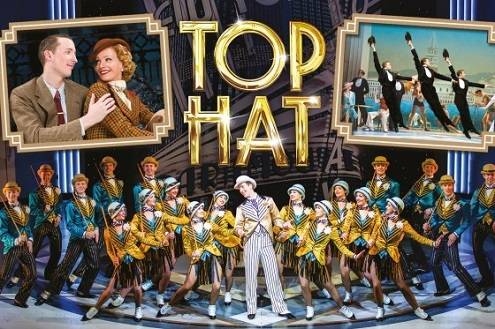
Top Hat
Music and Lyrics by Irving Berlin
Adapted for the Stage by Matthew White and Howard Jacques
Photo by Max Lacombe-shaw
Review by Paul Tyree
Direct from huge success in London, where it won three Olivier Awards and the Evening Standard award for Best Night Out, you can easily see why this musical has become so popular so quickly.
Telling the story of American Musical Revue star Jerry Travers who inadvertently wakes up Dale Tremont, his downstairs neighbour, with his tap dancing, the pairs’ immediate attraction to each other sets off a tale of mistaken identity and musical and comic mayhem to rival any in musical theatre history.
What makes this production so sublime is its mastery in every theatrical department from the music to the costumes from the singing and dancing over fantastic sets there really is not a foot put wrong here. The sheer hard work, which looks effortless although undoubtedly it isn’t makes this a glorious night at the theatre.
The leads, Alan Burkitt and Charlotte Gooch are both charming and faultless. The talent required to be able to sing whilst in the middle of a tap routine cannot be overstated. The number of hours of gruelling rehearsal must have been quite mind-boggling and then to produce the performances they do makes them worth the price of admission alone.
Also quite fantastic and pretty much stealing every scene he is in is John Conroy as Bates, a quarrelsome butler. Special mention too for Sebastien Torkia as Alberto Beddini, Dales’ adoring and ambitious Italian dressmaker.
This, importantly, is musical theatre at its best. It does not skimp in any department, nor does it flag at any point. It comes across as hugely professional and in those terms very respectful of its audience, who were wowed by an evening that will stick in the memory for many years to come. If you can get a ticket it will certainly be worth it as you will not find any finer that this.
Lyceum
- 55 Norfolk Street, Sheffield, S1 1DA, South Yorkshire, United Kingdom
To order tickets ring Sheffield Theatres Box Office
Telephone Numbers
Box Office: 0114 249 6000
Crucible/ Lyceum Theatre Switchboard: 0114 249 5999
Buy Tickets online at: http://www.sheffieldtheatres.co.uk/
Hamlet goes to school
By Dan ZbijowskiHamlet is Shakespeare’s most performed and arguably most complex play. It was with a little trepidation then that I ventured to the Cockpit Theatre in Marylebone to witness the latest offering from the English Repertory promising “no ghost, no equivocation, only revenge”. With a running time of under two hours including interval, this is an ambitious, fast paced, and darkly comic, reduced take on the Bard’s most famous work.
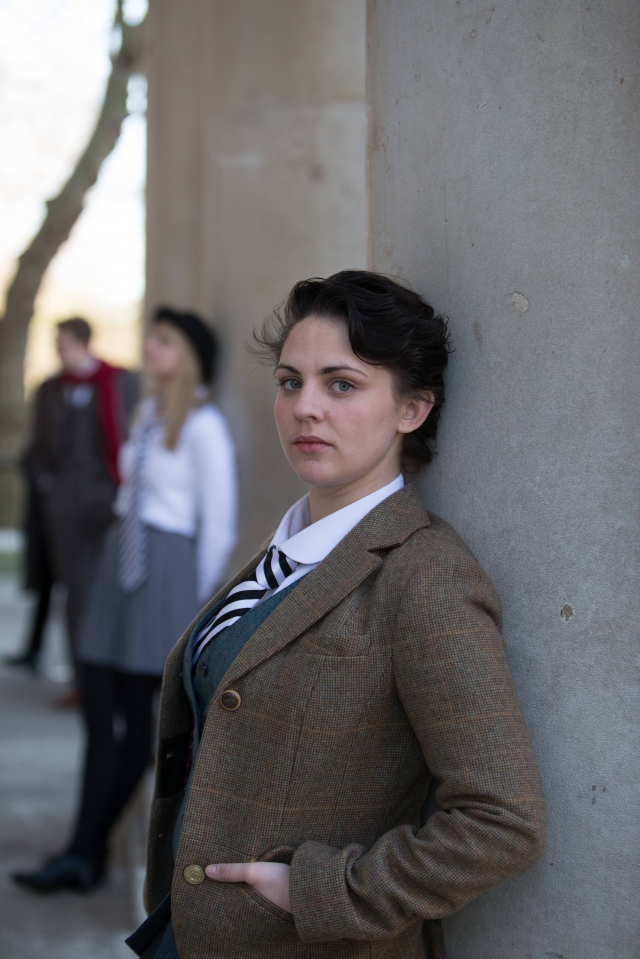 Rachel
Waring is excellent as Hamlet
Set in a school we meet twins Laerte and Ophelia taught by the slightly uncomfortable David Alwyn as Horatio, with fellow ‘student’ Rosencrantz acting as substitute for many of the plays other minor characters. The play opens with Horatio teaching his class the history of Denmark, a skeleton in the corner oversees the drama and foreshadows the tragedy to follow.
Hamlet enters late with a bustle, his father has been murdered by his uncle who is now married to his mother. Rachel Waring’s Hamlet is an impish, frantic and delightfully mischievous portrayal of the Danish prince. At 26 the productions flyer proudly proclaims her the youngest woman ever to play the role, and a fantastic job she does of it too. It is a performance of real note, she adds an urgency and distraction to the part that draws the eye even when not immediately involved in the action.
The first half has great energy, notes being passed between giggling school children, characters chasing one another on and off set through each and all of the 4 stage exits. But whilst the first is delivered at breakneck speed, the second half drops in pace and changes in tone. With the performance running at just 90mins there is an argument about whether an interval is needed at all. It does feel somewhat disruptive coming as it does, but I am not sure if the play would have worked as well without one, such is the sudden shift in direction.
A reduction of this sort, Hamlet’s usual running time is around the 4hr mark, requires much cutting, and whilst several of the characters are lost some of the longer speeches are maintained with little certainty as to why.
The actors are all fantastic, poor Polonius, both the put-upon Headmaster being led a merry dance by rebellious students, and also proud Father to Ophelia. He is at first suspicious of Hamlets intentions towards his daughter, but becomes increasingly proud that she has in fact managed to woo Hamlet. As much as the credit will rightly go to Waring for her ferocity in the title role, Oliver Hume is equally deserving of the plaudits. His is a comic and highly tragic Polonius, one who perfectly encapsulates the old adage ‘pride comes before a fall’.
Claudius the king, wears a suit and a frown that gives him the demeanor of a school governor, his wife and Hamlet’s mother Getrude is flirtatious and knowing, whilst Nina Bright offers a beguiling Ophelia. The lovelorn pawn in Hamlet’s game, her scene of madness is handled deftly with a rendition of ‘Tainted Love’ and is a clear benefactor of brevity adding clarity.
The setting of the school works fantastically well in certain respects and distracts at others, for example it removes the need for the players. These parts are absorbed by the twins and Rosencrantz as Hamlet gets his fellow reluctant students to act out a ‘school play’ to uncover Claudius as his Father’s murderer. Likewise the tables, used to great effect they add real tension as Claudius throws them one by one whilst a cowering Hamlet hides beneath them. They also hinder, much of the menace of Laertes and Hamlets dual is lost through their need to constantly duck in and around the strewn props.
Reducing the text significantly also causes a reduced cohesion with this production. The omission of the ghost removes context and the interactions between Hamlet and the Queen Gertrude lack the depth needed to fully explore the dynamic of the mother son relationship central to Shakespeare's play. Those unaware of the original text may lose some impact and understanding of the play as a result.
None the less this is a bold, brave and very modern take on a great play. Gavin Davis deserves credit for both his staging and the fine cast that he has assembled. It is a highly entertaining production and represents either a great first foray into Shakespeare for the novice, or a refreshingly novel take on a classic for the old hand.
As a final note, the Cockpit theatre has an apparent capacity of 240 when staged in the round and it was somewhat disappointing to see a crowd of only 40 or so there to witness this production on the Tuesday I was there. The stellar cast certainly deserve a bigger audience for their work. Running until the 15th March it’s worth a visit and I’d welcome your thoughts on the production in the comments below.
By Dan Zbijowski
Until 15th March.
The Cockpit Theatre, Gateforth Street, London NW8 8EH
Box Office: 020 7258 2925
More information: http://www.thecockpit.org.uk/show/hamlet_0
Three Men in a Boat at the Theatre Royal Windsor
By Clare Brotherwood
Even though I have seen a few other productions of Three Men in a Boat, I don’t think I’ve ever seen one which is so off the wall.
Produced by The Original Theatre Company and the Theatre Royal Bury St Edmunds, director Craig Gilbert’s first full length play bows more to Monty Python than the Victorian solicitors’ clerk’s account of his holiday on the Thames in an open skiff with his friends Harris and George. They’ve even got a ‘funny walk’ in it, while fox terrier Montmorency (who was, incidentally, fictional) reminds me more of the dead parrot sketch.
But looking through my own copy of the book, I have to admit that they do pretty much stick with the original dialogue – until you come to the music hall song and dance routines, the accompanying pianist and the fact that this show is set in a pub!
J is giving a talk about his journey in said pub as the village hall has been destroyed (no going half measures here). His audience is the theatre audience and as he attempts to tell his tale his two friends get up to all sorts of jolly japes.
It’s almost silly schoolboy humour, but the timing is spot on, with the three actors, David Partridge as J (looking uncannily like John Cleese), Michael Rouse as George and Tom Hackney as Harris, in an almost choreographed piece with some very impressive quick changes.
Anna Westlake as Nelly the pianist (and accordionist) fits in easily as their accompanist and adds much to the show with well thought-out tunes and some little cheeky asides.
Three Men in a Boat is at the Theatre Royal Windsor until Feb 28.
Box office: 01753 853888
www.theatreroyalwindsor.co.uk
It then continues touring:
Mar 3-7: Devonshire Park Theatre, Eastbourne
Mar 23-25: Mercury Theatre, Colchester
Mar 26-27: Venue Cymru, Llandudno
www.originaltheatre.com
Various children's shows
By Clare BrotherwoodAs I’ve said before, children’s entertainers are often overlooked. And yet children’s theatre is the most important part of the industry. Do it right and you’ve got them for life. Do it wrong and you may never get them on board.
With this in mind, I took myself off to some children’s shows during half term to see just what is on offer for, hopefully, our next generation of audiences, performers, directors and technicians.
My local arts centre, Norden Farm Centre for the Arts in Maidenhead, was buzzing. There was something on all day every day, from storytelling in a gypsy caravan-style tent complete with floor cushions, to family friendly movies and arts and crafts sessions.
But it was the children’s shows I wanted to see, and I was not disappointed. While many may think there is not much to entertaining little ones, nothing could be further from the truth. The shows may look simple but it takes a lot of skill to keep young minds engaged for 50 minutes, and today’s entertainers come with skill in abundance.

Image credit: Andy Sapey courtesy of Ripstop Theatre
First off was Zannie Fraser who, in 1998, formed her own theatre company, Ripstop Theatre, which went on to be the first British company to perform at the International Shadow Theatre Festival in Germany in 2003.
Inspired by the Collingley Fairies, supposedly photographed in 1917, Zannie’s show, A Real Fairy Story, really is magical – to the point where a fairy levitates under a piece of cloth and words disappear from a book.
As Miss Amelia Buttersnap, a fairy expert who has never seen a fairy, Zannie incorporates all sorts of paraphernalia to hunt down fairies and photograph them – and when someone sends her a captured fairy she transforms it into exquisite scenes of shadow puppetry.
Andy Lawrence is an imposing figure with his white pointed beard and love of hats, but he takes children’s entertainment to another dimension with a myriad of puppets and sublime storytelling.
Andy trained and worked as a theatrical costume designer but now, under the title of the Theatre of Widdershins, he uses his skills to create imaginative, innovative shows and workshops which leave his audiences wide-eyed and open-mouthed.

Image
courtesy of Widdershins Theatre and
Norden Farm Centre for the Arts
The Magic Porridge Pot and Other Tasty Tales comes in three parts. Scenery pops out of boxes like Russian dolls and animals, including a giraffe, unfurl from buckets, porridge threatens to flood the home of Granny Grimpickle and her lifelike dog Podge, stone soup is served and a gingerbread man runs wild. Together with original music, jokes for parents/grandparents and Andy’s unique personality, this three-course show is a veritable feast.
Finally, I made the journey to the Lyric Hammersmith to see the Blunderbus Theatre Company or, rather, gifted young actor Ben Sbuttoni.
Blunderbus was also set up in 1998 and has such a good reputation that when it was touring in Malaysia recently two storytellers made a special trip from Indonesia just to see the show. Their shows are bright, colourful, and involve the young members of their audiences with slapstick and squirting of water.
But it was Ben I wanted to see. Expressive, outgoing, but with a wide-eyed innocence and a cheeky grin, he is a natural performer and a great favourite with children. Together with his co-star Simon Sanchez, he had the audience in fits of giggles as they told the story of Dotty the Dragon.

Image courtesy of Blunderbus
Judging by the sell-out shows last week and the happy, excited children leaving each venue, it looks like children’s theatre is thriving – and long may that be!
NEW YORK REVIEW: Churchill
By Cameron LoweBy Lucy Komisar in New York
The back story of “Churchill,” the solo play finely adapted and performed by Ronald Keaton, is class politics. Though I’m not sure the author meant it that way. Winston Churchill was to the manor born. His grandfather was the Duke of Marlboro and Viceroy of Dublin, his father Henry Spencer-Churchill (Lord Randolph) was a Conservative member of parliament who hadn’t done well at Eaton. Winston couldn’t get into college and took the exam three times to finally get into Sandhurst, the British military academy. Privilege screams.
Keaton is very good as the middle aged Churchill, offering a view of the man that shows personal sensitivity as well as political astuteness. And director Kurt Johns, moving Churchill through time and the backdrop slides seen through large windows, makes you forget there is only one performer in the space.
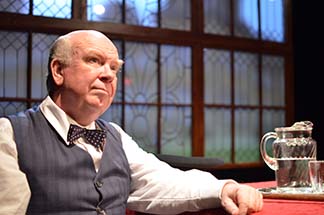
Ronald Keaton as Winston Churchill at table, photo Jason Epperson.
Churchill starts out typical Brit upper upper. He recalls that he was closest to his nanny, and declares that, “She’d lived such an innocent and loving life in service to others that she had no fears at all and did not seem to mind very much. She’d been my dearest and most intimate companion for all of the first twenty years that I’d lived.”
What the upper class thinks of servants who don’t seem to mind very much that they have no lives of their own!!!
His own father apparently cared much less about him. He says he had five conversations with his father over his lifetime. He was sent to boarding school at 7 and recalls a sadistic headmaster who flogged students with a cane. When he was at Harrow, his father never visited, and he died at 45.
The inherited sickness of that upper class, the inbred cruelty, perhaps explains why Churchill despised socialism – a system that attempts to share wealth and opportunity, dominated by the very privileged, such as the Churchills, with the ordinary citizen.
The set is a table with a red cloth and a couple of black leather chairs. The back windows are used for slides of place.
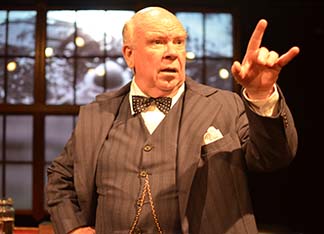
Ronald Keaton as Winston Churchill making a point, photo Jason Epperson.
Keaton as Churchill is a slightly rotund fellow. He is dressed in a striped suit and vest with gold watch chains. He doesn’t sound like Churchill, but that’s not important. He gives you the feeling of the man.
The play starts in March 1946 and much is in flashbacks. After being wartime PM in Britain, he is defeated for reelection by a Laborite, Clement Attlee. We see him before an easel at Blenheim Palace, home of his grandfather, the Duke of Marlboro.
It’s not explained why he was defeated. Well, the war was over, maybe Brits who had suffered a lot didn’t feel the need to suffer more at the hands of a conservative aristocrat who despised socialism.
So, flashbacks. He holds a cigar he picked up in Cuba where he went as a military office. Then he is assigned to India. He writes a best seller, then goes to Sudan and with influence – influence is always important — gets onto that commander’s staff. He sends columns to a newspaper. He makes money from a book on Sudan, resigns his commission and runs for parliament in 1898. What else could an upper class boy trained only in war do?
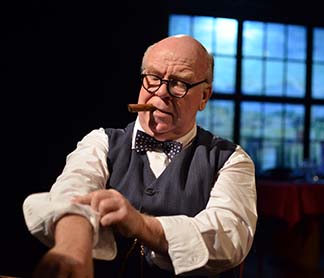
Ronald Keaton as Winston Churchill rolling up sleeves, photo Jason Epperson.
Churchill wins in 1900 and in 1901 enters the House of Commons as a member of the Conservative party. Then curiously he switches to the Liberals of Lloyd George, the son of a Welsh coal miner. The party supports legislation that FDR incorporates into the New Deal. Churchill says, “I was regarded as a traitor to my class.” Lloyd George makes him secretary of state, then First Lord of the Admiralty. He is prescient about World War I and fights in France. There’s no clear explanation of why Churchill changed his stripes.
Afterwards, the Liberal government is defeated by the Socialist Party, led by Ramsey MacDonald. Churchill attacks him as “a Calvinist. A pacifist. A teetotaler.”
Still, Churchill doesn’t have to scrounge for a job. At his Chartwell estate, he paints and keeps race horses. And switches back to the Conservative party.
He opposes the Munich deal of his fellow Conservative Neville Chamberlain, arguing, “You will get war.” Keaton has him say that, “All but one of Britain’s newspapers had supported Chamberlain” and “some even in my own cabinet wanted me to negotiate with the Nazis at home and even abroad. Like your own ambassador Joseph Kennedy, who predicted our defeat and counseled surrender.” Churchill is put in charge again and rouses Britain to commit their “blood, toil, tears and sweat.”
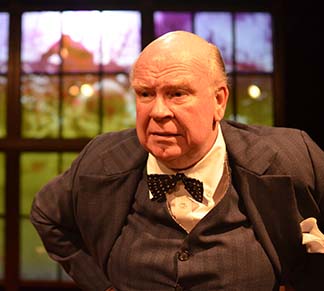
Ronald Keaton as Winston Churchill, Chartwell estate seen through window, photo Jason Epperson.
After the war, when there are calls for his retirement, he says, “I leave when the pub closes.”
But, one can appreciate the Sandhurst military man’s achievement in wartime without wanting the hater of socialism and the patronizer of his nanny to run the peace.
Back in Chartwell, Churchill gets an invitation from U.S. President Truman to speak in Fulton Mo. There, he gives his famous Iron Curtain speech: “From Stettin in the Baltic to Trieste in the Adriatic, an iron curtain has descended across the continent.” The speech announces the beginning of the Cold War.
Ronald Keaton’s very absorbing play is both a history lesson, of a statesman defending Britain, and a chronicle of class, of an aristocrat opposing the political influence of workers. Plaudits to Keaton if he meant it that way.
“Churchill.” Adapted and performed by Ronald Keaton; directed by Kurt Johns. Based on the life and words of Winston Churchill and the teleplay “Winston Churchill” by James C. Humes. New World Stages, 340 West 50th Street, New York City. (212) 239-6222 or (800) 872-8997. Opened Feb 18th, 2015; tickets through May 31, 2015. 2/23/15.
Lucy Komisar is a New York Journalist and Theatre Critic. Her web site is The Komisar Scoop.


